Breaking: Manufacturing Enters Simulation-First Era
The traditional design-build-test cycle is officially obsolete. High-fidelity simulation, powered by NVIDIA's OpenUSD standard, now produces synthetic training data accurate enough for production-grade AI, enabling perception systems and agentic workflows to thrive in live factory environments.
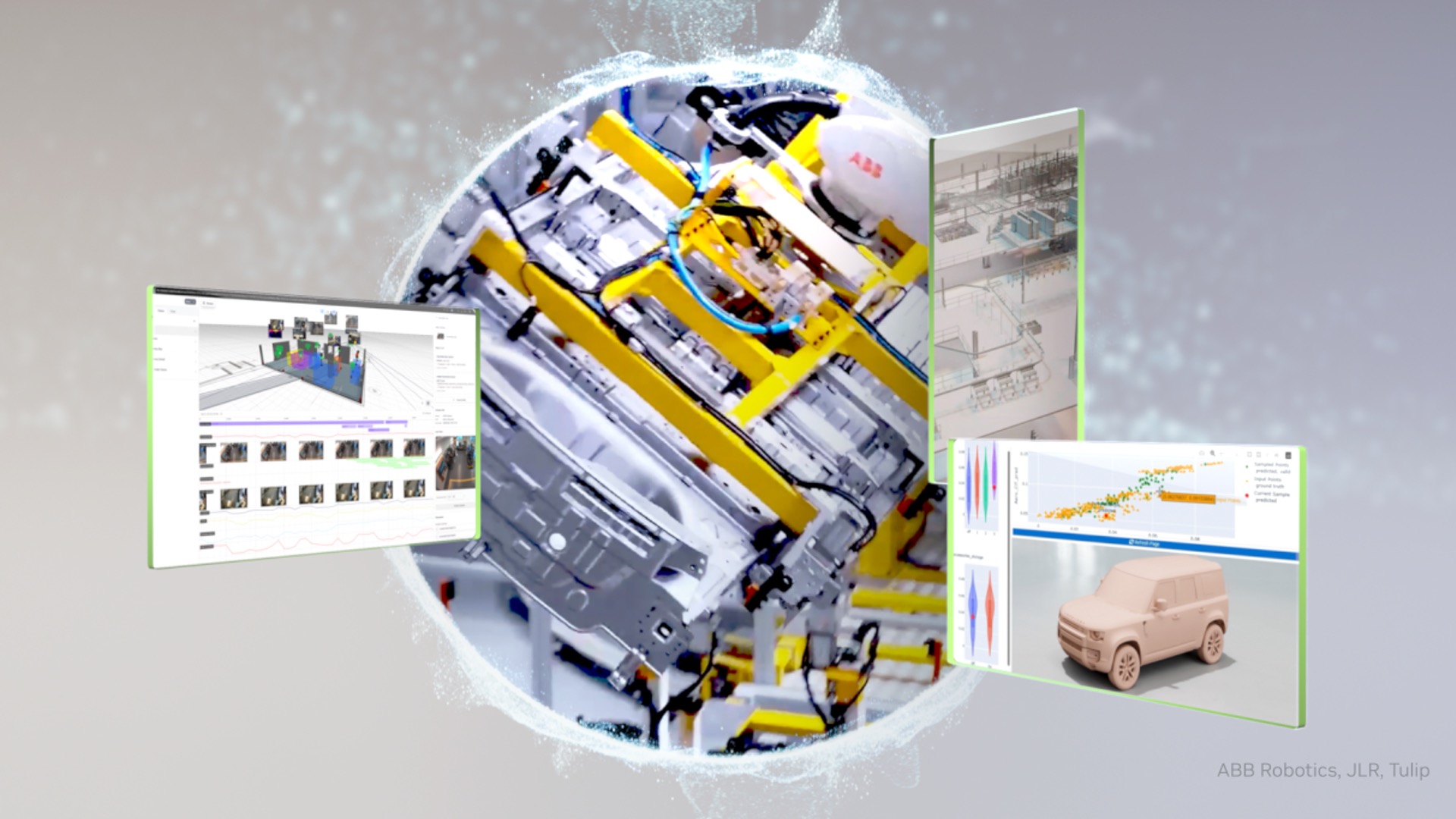
Manufacturers leveraging this shift report measurable results—up to 99% simulation-to-real accuracy, 50% faster product introductions, and dramatic cost reductions.
SimReady: The New Content Standard for Physical AI
A foundational challenge has plagued industrial operations: 3D assets lose physics properties, geometry, and metadata when moving between CAD, simulation, and AI pipelines. SimReady, built on OpenUSD, defines what physically accurate assets must contain to work reliably across rendering, simulation, and AI training.
NVIDIA Omniverse libraries add a physics-accurate, photorealistic simulation layer where AI models are trained and validated before deployment.
ABB Robotics: 99% Accuracy in Sim-to-Real Transfer
ABB Robotics integrated NVIDIA Omniverse into its RobotStudio HyperReality platform, used by over 60,000 engineers globally. Robot stations are now represented as USD files running the same firmware as physical counterparts—enabling training, part tolerance testing, and AI validation before any production line exists.
“We’ve managed to vertically integrate the complete technology stack and optimize it to a point where we’re now achieving 99% accuracy on the simulated version,” said Craig McDonnell, managing director of business line industries at ABB Robotics.
Results: up to 50% reduction in product introduction cycles, up to 80% reduction in commissioning time, and a 30–40% reduction in total equipment lifecycle cost.
JLR: Aerodynamic Simulation Compressed from 4 Hours to 1 Minute
JLR applied the same simulation-first principle to vehicle aerodynamics. Engineers trained neural surrogate models on more than 20,000 wind-tunnel-correlated computational fluid dynamics simulations across its vehicle portfolio—achieving 95% of aero-thermal workloads now running on NVIDIA-powered systems.
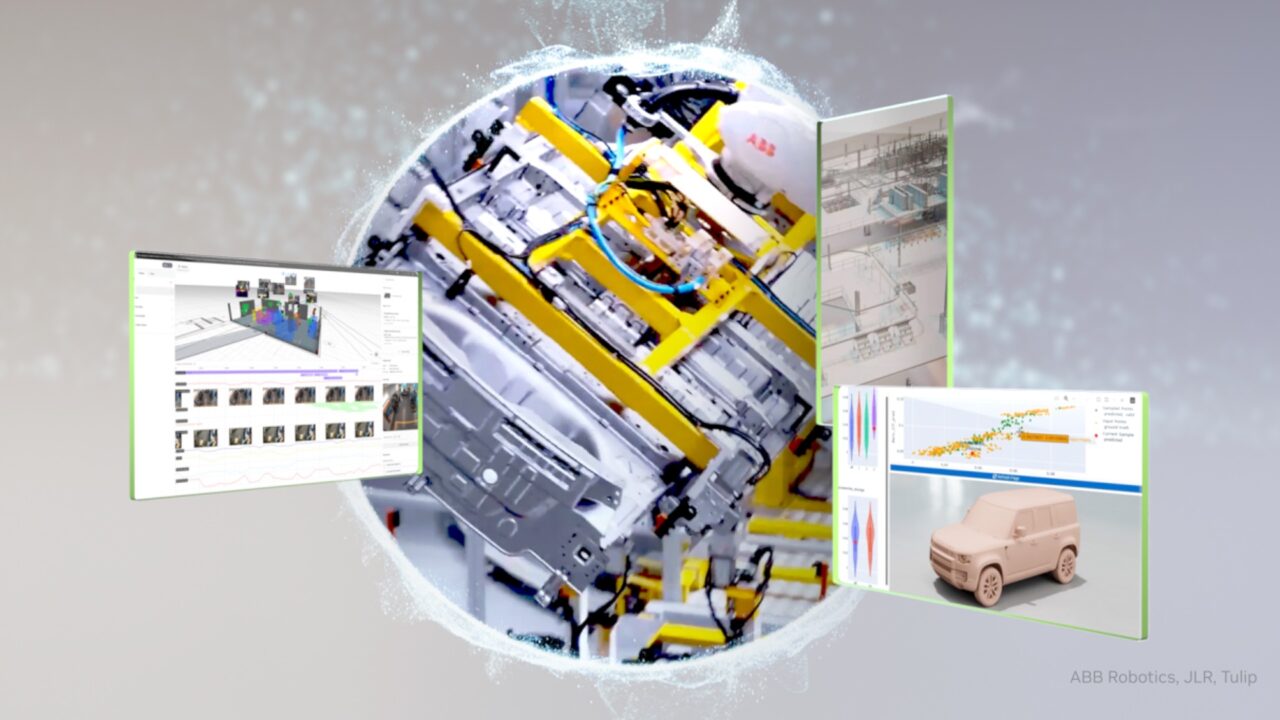
The massive speed-up—from four hours to one minute per simulation—unlocks rapid design iteration and real-time optimization.
Background: Why the Shift Matters
For decades, manufacturing’s design-build-test cycle assumed that real-world testing was the only reliable environment. This assumption limited speed, increased costs, and created bottlenecks in product development.
The emergence of OpenUSD as a connective standard changes that. It allows assets to move seamlessly between tools, preserving fidelity. Combined with NVIDIA’s GPU-accelerated simulation, manufacturers can now iterate virtually before committing to physical prototypes.
What This Means for Manufacturing
The simulation-first era enables faster innovation with lower risk. Companies can train AI models, test tolerances, and optimize workflows without building physical lines or wind tunnels. The result: shorter time-to-market, reduced costs, and higher quality.
As more manufacturers adopt OpenUSD and Omniverse, expect industry-wide acceleration—where digital twins become the primary development environment, and physical production is simply the final validation step.
Key Takeaways
- 99% sim-to-real accuracy demonstrated by ABB Robotics
- 4-hour simulations reduced to 1 minute at JLR
- OpenUSD now the standard for interoperable, physics-accurate 3D assets
- Cost reductions of 30–80% across product lifecycle